

A dry lot can turn into a knee-deep mess faster than most horse owners expect. One hard rain, a leaking trough, and a week of hoof traffic can turn the gate, feeder, and water area into slick, manure-filled mud. Effective dry lot mud control is not about throwing down a load of gravel and hoping for the best. It is about moving water away, building a surface that can carry traffic, and managing the spots horses use hardest.
Mud is more than an inconvenience. It creates extra chores, tracks into stalls and trailers, hides holes, softens hooves, and makes turnout less safe for horses and people. A sound plan protects your investment in the property while giving horses a cleaner, more usable place to move.
Most mud problems begin below the surface. Clay-heavy or compacted soil does not absorb water quickly, so rain and runoff sit where they land. Then horses repeatedly walk the same paths between the shelter, hay, gate, and water. That traffic churns wet soil into a slurry, breaks down the surface, and creates deeper ruts that hold even more water.
Water sources inside the dry lot often make the problem worse. Overflowing troughs, leaking hydrants, downspouts dumping near a fence line, and wash water from nearby barn areas can keep one area wet long after the rest of the lot has dried. If the lot is lower than the surrounding ground, runoff may be flowing into it from every direction.
The key point is simple: mud is usually a drainage and base failure before it is a top-surface failure. Surface material matters, but it cannot solve standing water with nowhere to go.
Before ordering material, walk the dry lot during or immediately after a rain. Look for where water enters, where it ponds, and where it exits. You need a clear route for water to leave the high-traffic area without creating an erosion problem elsewhere on the property.
A gentle grade is usually the first line of defense. The lot does not need to look perfectly flat. In fact, a slight slope away from barns, shelters, gates, and feed stations is what keeps water moving. The exact grade depends on the property, but the goal is always the same: water should shed off the use area rather than settle in it.
Redirect roof runoff before it reaches the lot. Extend downspouts, repair trough leaks promptly, and avoid placing water tanks at the lowest point when another location is practical. If the site has persistent runoff, a swale, French drain, culvert, or other drainage feature may be necessary. This is where a local excavation or drainage contractor can save money in the long run. Replacing surface material every season costs more than fixing the water path once.
A lasting dry lot surface is built in layers. Skipping the base is one of the most common reasons gravel disappears into mud within a year.
First, remove the loose organic mud, manure buildup, and unstable soil in the worst areas. Then shape and compact the subgrade so it drains as intended. On soft soils, geotextile fabric can be a smart addition. It separates the native soil from the aggregate above it, helping prevent gravel from sinking down and clay from pumping up through the surface.
Next comes a compactable aggregate base. The right material varies by region, but it generally needs a blend of stone sizes and fines that lock together when compacted. This base carries the weight of horses, tractors, manure spreaders, and delivery vehicles. A surface layer of clean, angular material can then provide traction and a more comfortable finish.
Avoid round river rock for horse areas. It shifts underfoot, does not compact well, and can be uncomfortable or unsafe for hooves. Also be cautious with sharp, oversized stone. A durable base does not have to mean a rough turnout surface. The material needs to match the area and the type of traffic it receives.
For heavily used locations, such as gates, hay feeders, waterers, and shelter entrances, a reinforced pad may be the best investment. Grid systems, mats designed for livestock use, concrete, or properly installed aggregate pads can reduce churn dramatically. These are the places where most dry lots fail first, so treating them as separate projects often makes sense.
There is no single perfect dry lot material for every property. Sand drains well but can migrate, develop holes, and become difficult to manage on certain soils. Dense aggregate holds up under traffic but may need a finer top layer for comfort. Wood products can look attractive at first, but they break down, hold moisture, and eventually become organic mud unless they are managed and replaced.
The right answer depends on your soil, rainfall, drainage, turnout schedule, herd size, and equipment. A small private dry lot with two horses may need targeted pads and grading. A busy boarding barn may need engineered high-traffic lanes and multiple hardened stations to handle constant use.
Think about manure management before finalizing the surface. If you pick daily by hand, a smaller top material may work well. If you use a tractor or drag, choose a surface that will not be scraped away with every cleanup. Any material that traps manure and moisture will lose performance over time.
Many properties improve the middle of the dry lot but leave the edges untouched. Then horses carry mud in from the gate, stand in a wet shelter entrance, or walk through a low spot on the way to water. The result is a dry lot that still feels muddy because the highest-use transitions were never stabilized.
Pay close attention to the path from barn to turnout, the gate approach, the perimeter around water tanks, and the area outside run-in sheds. If horses stand there for hours during bad weather, it deserves the same attention as the center of the lot. A narrow, well-built lane can make daily turnout safer and keep mud from spreading across the property.
Fence lines deserve consideration too. Horses often pace along them, especially where they can see pasture mates or activity in the aisle. If one side of the lot becomes a permanent track, address the drainage and surface there before the rut widens.
Even a well-built dry lot needs regular attention. Pick manure frequently, especially in wet weather. Manure and bedding hold moisture, break down into organic material, and clog the stone or footing that is supposed to drain.
Inspect after storms and at seasonal changes. Fill small low spots before they become craters. Keep waterers level and dry underneath. Clear drainage channels and make sure downspout extensions have not shifted. If a particular area repeatedly fails, do not keep adding a thin layer of material on top. Dig into the cause. It may need better grading, a deeper base, or a way to move water around it.
Surface conditioners can also have a place in a broader property plan when dust becomes the next problem. Once a dry lot is stable and draining properly, adjoining arenas, lanes, and dusty traffic areas may benefit from treatments that help hold moisture and reduce airborne dust. ARENACLEAR works with horse property owners looking to improve dirt and sand-based surfaces without relying on corrosive salts that can be hard on equipment, paws, hooves, and the surrounding environment.
There are times when a temporary solution is reasonable. If you need safe footing around a waterer before a storm, a properly placed mat or a small load of suitable aggregate can reduce immediate risk. If a gate is slick, a short-term pad can buy time until a larger project is possible.
But temporary material should not become the permanent plan. Repeatedly dumping stone into an ungraded mud hole often creates an expensive, uneven layer that still holds water. You may end up with buried rock, poor drainage, and a bigger excavation job later.
Put your budget where it changes the outcome: first control water, then stabilize the base, then select a horse-appropriate finish. Start with the worst high-traffic areas if a full renovation is not practical. A dry, firm gate and water station can improve everyday barn work immediately while you plan the rest of the lot.
A clean dry lot is built one decision at a time. Watch where water moves, harden the places horses use hardest, and correct small failures before they become a season-long mud problem. Your horses, your footing, and your daily chore list will all be better for it.
Equine professionals assess the effects of using magnesium chloride for dust control on soil, groundwater, trees, streams, ponds, MgCl2 disposal, land stewardship, and potential eco-friendly dust control options.
Magnesium chloride is commonly used to control dust in horse arenas, but research indicates it can cause lasting damage to soil structure, contaminate groundwater, harm trees and pasture grasses, and accelerate the corrosion of farm equipment. When exposed to moisture, magnesium chloride dissolves into highly mobile ions that travel through soil and water, increasing the risk of runoff pollution and long-term environmental damage. Understanding these effects enables equine professionals to make safer, more sustainable choices that promote healthier footing and dust control products without compromising health.
Dust Control is a daily reality for equine facilities, but the materials used to manage airborne dust can have lasting effects beyond the riding surface. In recent years, greater attention has been paid to how commonly used chloride-based products interact with soil, vegetation, and water systems over time. Understanding these interactions is increasingly important for horse owners, land managers, and professionals tasked with balancing respiratory health, land stewardship, and long-term property sustainability.
Over an 8-hour period, the Department of Labor and others would advise you not to inhale more than a tiny, microscopic number of FCS particles. This is difficult to do on a day filled with lessons. Take a glance at your boots after dragging your arena—highlights the importance of dust control.
Dust to fines. All sand contains Free Crystalline Silica, a well-documented carcinogen. Recently, the U.S. Department of Labor revised its PEL after reviewing 50 years of outdated scientific studies, many of which used inappropriate methods to establish their recommended Permissible Exposure Limits (PEL). In 2016, the Department of Labor lowered the limit to 50 µg/m3 over an eight-hour period and halved that for miners. (As an arena manager, you might feel like a miner of sand.)
Collectively, the American Lung Association, OSHA, the Department of Labor, and NIOSH-CDC consistently warn that repeated unprotected exposure to tiny amounts of FCS can cause chronic, often fatal diseases while stressing “there is NO SAFE EXPOSURE LIMIT”.
Penn State Extension: https://extension.psu.edu/riding-arena-footing-material-selection-and-management/ suggests “Allowing 5 to 10 percent fines (passing through a number 200 screen, which has a 0.075 millimeter hole size).”
Most horse arena footing materials last 5 to 7 years, while Silica Sand lasts 10 years. Silica Sand’s longevity may sound attractive, but it carries the highest levels of Free Crystalline Silica & expense.
Silica sand is often specified with fabric/sand or rubber/arenas because of its durability, not because it is the healthiest option for horses or humans.
Alternative sands can be local and reasonably priced, with significantly less FCS; just ask your local State University Extension for help.
Maintenance is crucial: The condition of the arena footing can influence its lifespan. Poorly maintained footings become compacted and dry, and sand fractures turn to respirable fines more quickly.
While gentle, steady dragging, combined with eco-friendly, moisture-retaining dust-control products, helps keep sand particles bound, improving stability and extending the footing's durability.
Recommended Arena Maintenance Schedule
Your disciplines, footing type, and usage dictate the ideal dragging schedule:
| Usage Level | Recommended Frequency |
| Low Use (1-2 horses/day) | Once a week |
| Moderate Use (2-4 times a week) | 2-4 times a week |
| Heavy Use (Daily or 10+ horses) | Daily, sometimes twice a day |
| Competitions/Events | Several times per day |
Eventually, every arena becomes worn, dusty, or too shallow, and the footing must be replaced. What we choose next-and how we dispose of the old material- determines how we protect our land and water for future generations.
What are the responsible options for disposing of old footing contaminated with magnesium chloride or salt? Why shouldn’t it be spread on pastures or paddocks?
Given dust in both outdoor and indoor environments, equine professionals use various dust-control products to manage it. A growing concern is the use of ice-melt products, such as magnesium chloride (MgCl₂) or chlorides, as arena dust suppressants.
Arena footings are not inert; they collect manure, urine, hay, magnesium chloride, sand, dirt, salt, or synthetic oils.
The footing also affects magnesium behavior, and environmental impact depends on your sites, rainfall, snowmelt, and soil drainage.
Many professional facilities managers’ report needing 2 pallets of Mag Flakes each year. The lifespan of ice melt, cost, and the long-term (5-7 years) buildup of chemical and ionic loads in soil raise important questions we may consider.
INDOORS, in a humid barn, ice-melt flakes dissolve as they absorb moisture from the air, creating a salty brine that can liquefy upon contact with moisture.
Innocently, wheelbarrows full of MgCl2 are carried directly from our arenas to manure piles or storage containers that may be exposed to rain or snow and leak onto nearby ground.
For equine owners, the environmental consequences of chloride accumulation extend beyond indoor & outdoor arenas. Soil degradation can impair pasture growth, limit nutrient uptake, and harm water sources. Over time, this can affect forage quality, increase erosion risk, and compromise long-term usability and property values.
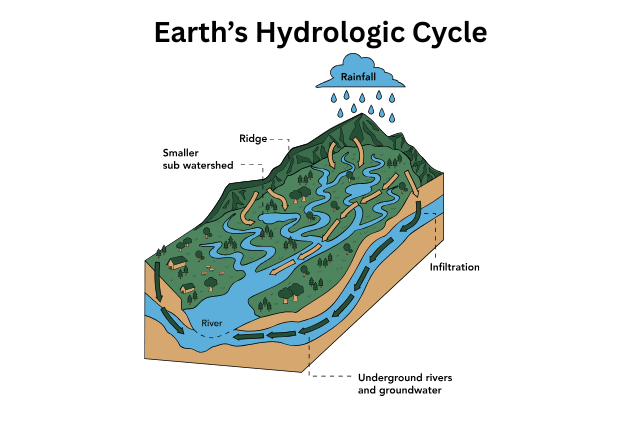
The Hydrologic Cycle continuously moves water through evaporation, condensation, precipitation, runoff, and infiltration into rivers, streams, creeks, or rock-bed cracks, then into the groundwater table, gradually flowing toward the seas via underground channels that constantly carry water back to the oceans. Therefore, the chance that pollutants from runoff reach larger bodies of water is high.
Although this example isn't an exact match, it demonstrates the broad harmful effects and the potential for pollutant exposure to cause groundwater contamination and ocean acidification.
The landmark case County of Maui v. Hawaii Wildlife Fund highlights this link. Maui County released treated sewage water into underground wells 10 miles from the ocean, which reached the Pacific Ocean.
The US Supreme Court case (2020) held that discharging pollutants into groundwater (that eventually reaches "navigable waters" (like the ocean) needs a Clean Water Act permit if it's the "functional equivalent" of a direct discharge, may require a Clean Water Act Permit, recognizing that distance and time do not negate impact.
Water, Erosion & Ecosystem Effects: https://www.EPA.gov/water-research/national-stormwater-calculator and associated impacts. The EPA (1999) states, “100 tons of sediment per acre can be lost when not managed.” “Many farms in the U.S. see losses anywhere from two to five tons of soil per acre each year. ”Good practices to prevent erosion include rotation and cover crops.
Eroding soil contaminated with MgCl2 can increase the solubility of heavy metals bound to clay particles. When precipitation occurs, there is a high chance that these metals will be released into the groundwater, streams, fishponds, and wells, causing contamination.
Metals commonly found to be mobilized by magnesium chloride runoff include:
According to U.S. Environmental Protection Agency data and soil engineering studies, magnesium chloride primarily solubilizes heavy metals via an ion-exchange process involving chloride complexation.
CO State University Extension’s research study reported unexpectedly high levels of Pb, Zn, Cd, and phosphorus in streams near MgCl2-treated roads, illustrating how localized use can result in watershed-wide exposure beyond the initial application site.
MgCl2 is mixed with sand, dirt, and clay, and it dissociates into ions. Highly soluble ions then exchange charges with other “cations” held by negatively charged exchange sites on soil particles. The released “metal cation” dissolves in soil water, making it mobile. This can seriously harm aquatic life and pollute the hydrologic cycle.
But wait, there is more: At even higher concentrations, chloride ions can also form soluble chloride complexes, increasing both mobility and solubility, which is a major environmental concern.
U.S. Environmental Protection Agency: “Chloride in Drinking Water”
EPA documents “chloride accumulation in soil and water, noting phytotoxic effects on vegetation, altered soil chemistry, and long-term impacts to groundwater and surface water associated with road deicing & dust control salts.”
Soil & Plants- How Magnesium Chloride Affects Horses
When chloride ions are absorbed by plant roots and travel through the plant’s water system, they accumulate at the edges of leaves and needles. Salt toxicity pulls water from the plants' roots via osmosis, causing dehydration and dieback.
Runoff and infiltration from fields and pastures contaminated with legacy footing materials, MgCl2, and salt enable highly soluble, mobile chloride ions to migrate through the soil and reach groundwater.
Once introduced, these compounds are transported by natural hydrologic processes, affecting pastures, crop yields, vegetation, trees, and soil health well beyond the source, and they can intensify the long-term environmental impacts of the pollutants.
Salt Toxicity:
Soil with high chloride levels can damage forage quality and plant growth. Salt-stressed legumes and grasses may be less nutritious or more unappealing to horses and can contain elevated levels of metals, which could affect horses that eat them.
Horses need Trees
Tree cover offers natural shade that helps horses regulate their body temperature, reduce heat stress, and prevent dehydration and electrolyte imbalance during hot months. In winter, trees serve as socialization spots and windbreaks against the harsh, cold winds, reducing heat loss.
Well-placed trees:
Cornell University Cooperative Extension – Road Salt Injury to Trees & Shrubs: Extension research links chloride exposure to canopy thinning, increased limb mortality, and irreversible decline in woody plants near treated roadways.
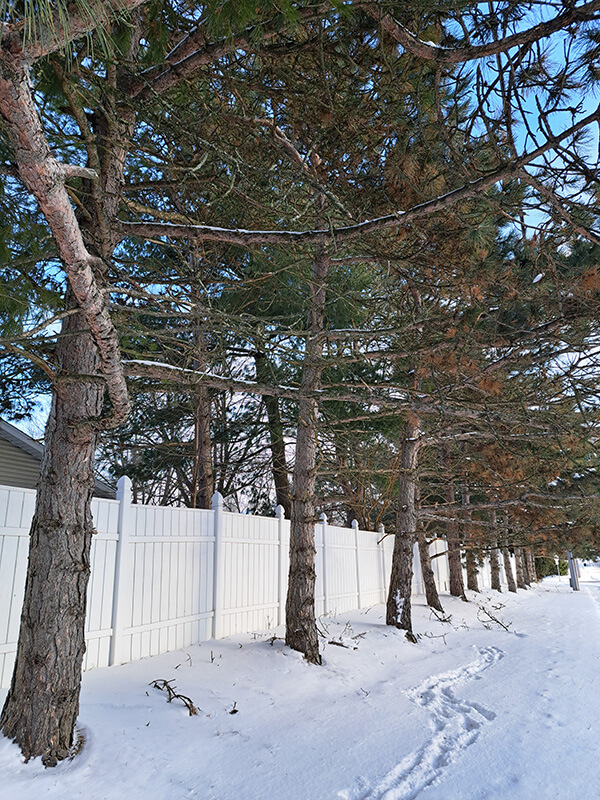
Symptoms: Signs of damage to trees include thinning foliage, dying, bare branches & “tip burn,” marginal necrosis, or “browning of the leaf edges,” and leaf scorching. High concentrations weaken or kill plants. Trees damaged by chloride can suffer root injury and reduced microbial activity, both of which are essential for plant survival.
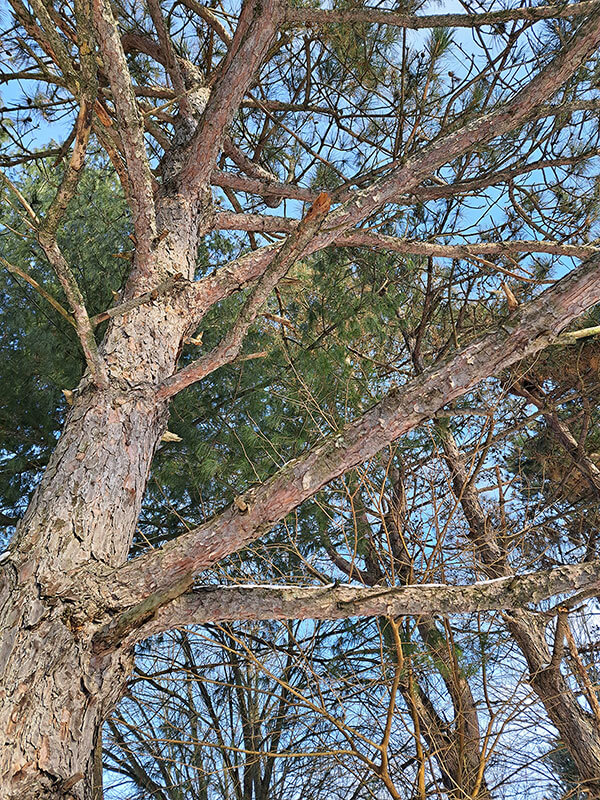
Only 2% of all plants and trees, known as halophytes, tolerate salt and are usually found near salty marshes or ocean inlets affected by tides.
*Below is an article that offers a comprehensive list of low- to moderate-tolerance trees and plants resistant to chloride ions for your use.
“Plant Tolerance to Calcium and Magnesium Chloride Concentrations Nov. 22, 2019”
When stagnant water cannot penetrate the surface, the top layer displaces oxygen, effectively suffocating roots & beneficial soil organisms.
Magnesium ions cause clay particles to stick together, reducing pore space. Excess chloride salts cause soil compaction and reduced drainage, leading to muddy conditions or waterlogging.
Compact soils lack open pore space that normally allows minerals, nutrients, and oxygen to reach plant roots. These microorganisms help break down organic matter. Without proper drainage, the area can erode, cause runoff, and harm plant life. Over time, this results in anaerobic conditions and a decline in soil health.
Nutrient imbalance: High magnesium levels displace other essential ions, such as calcium and potassium, leading to deficiencies even when they are available.
International Society of Arboriculture: Roadside Vegetation Health & Condition and MgCl2 Dust Suppressant Use in Two Colorado Counties share: “Roadside vegetation health and MgCl2 dust suppressant used in two Colorado counties revealed that most tree damage resulted from MgCl2 accumulating in roadside gullies.” Evidence in the study indicated that damaging aerosol spray can reach trees up to 300 feet from the road.

Trees and vegetation exposed to chloride mists suffer foliar burn; within just three years, they may become brittle, experience leaf or needle loss, or die, resulting in a loss of sound barriers, privacy, and decreased property values.
Proof in the pudding: Roads are designed to slope and shed water, preventing pooling and ensuring safe travel—when high concentrations of magnesium chloride drain to the leaning side, they form a reservoir of MgCl2 ions that can last for years. MgCl2 contains 17 to 56% more chloride ions than salt.
Next time you drive along a state route or major highway, observe the roadside trees. Large 18-wheelers, campers, and cars release a spray of magnesium chloride or salt, soaking nearby vegetation.
Magnesium is hygroscopic; it has the property of attracting and holding water molecules (moisture) from the surrounding air.
This process can occur through either absorption (water being drawn into the material) or adsorption (water sticking to the surface of nearby objects).
Unique to MgCl2 is its propensity to “deliquesce"—absorb moisture from the air and form a “corrosive solution” on metal at CRH (critical relative humidity) of 33-34%, creating a liquid electrolyte layer that sticks to the metal surface at room temperature. Corrosion Effects of Magnesium, Chloride, and Sodium Chloride
American Galvanizers Association shares a two-phase CO study completed by the CDOT found that “in the wet stage, MgCl2 was more corrosive.”
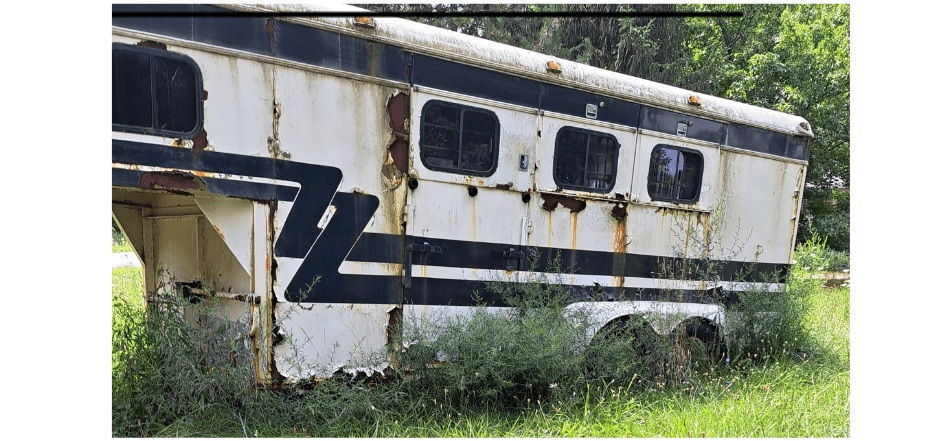
MgCl2 has high viscosity and even greater hydrophilicity, with a tendency to adhere to and crystallize on metal surfaces during higher summer humidity. Parked horse trailers, tractors, drags, campers, motorhomes, your Ford Super Duty-450, pasture gates, hinges, or your favorite metal pick may be at risk.
Best Management Practices-disposing of MgCl2 includes:
Planning, selecting, and implementing best management practices
**This article is intended to be strictly used for information or educational purposes only & your reading pleasure. These references are not meant to be comprehensive and do not preclude or exclude the use of other technically sound practices. Local state or government requirements may also apply.
FAQs:
Disclaimer* Importantly, just as you select your horse, animal's feed, or vet, do your own research, read, and decide what practices and choices are right for you. We will be here when you need us.
About the author:
Teri Clark is an international magazine contributor with decades of experience, including serving as the former National Marketing Director of Stall DRY™ & OMRI-listed Red Lake Diatomaceous Earth™. Teri and her husband, John, now own ARENACLEAR™ Dust Control and WaterFREE ARENACLEAR™ & PastureDRY.
She has practical experience in arena footing, soil health, and environmental stewardship.
She understands that airborne dust poses a serious respiratory and ecological risk. Teri lives with heightened sensitivity to dust exposure and firsthand experience of how fine dust particles can overwhelm the lungs’ natural defenses when left unmanaged. Through her writing and extensive research, she educates equine professionals, land managers, and property owners on selecting effective, eco-conscious dust control solutions that protect human and horse health while safeguarding water & and preserving soil integrity.
Resources include, but are not limited to:
EPA-Super Fund Site US Magnesium Tooele County, UT
https://www.epa.gov/water-research/national-stormwater-calculator-Erosion & Run-off:
CO Dept of Transportation-co.-mag-chloride-environmental study: Report #DTD-R2002-4
PubChem-Magnesium Chloride MgC12 CID5360315-PubChem
Corrosion Effects of Magnesium, Chloride, and Sodium Chloride
Poison.org is ice-melt-products-harmful-to-pets-and-kids
NIH-National Library of Medicine compound summary Magnesium Chloride Corrosion Effects of Magnesium, Chloride, and Sodium Chloride
Magnesium Chloride Toxicity of Trees
American Galvanizers Association-Corrosion and chlorides
ECFR.gov “Code of Federal Regulations” Title 40 Land Disposal of ions Restriction
NIH-National Library of Medicine compound summary Magnesium Chloride
https://eco-solutions.net/the-growing-case-against-magnesuim-chloride
Foliar Damage, Ion Content & Mortality Rate of Five Common Roadside Tree Species Treated with Soil Applications of Magnesium Chloride
Disclaimer: This article is intended to inform, not prescribe. Just as you choose the foods, medicines, and healthcare or veterinary services that are right for you, we encourage readers to review the available information, conduct their own research, and make decisions they believe are best for themselves, their animals, their property, and the environment.
Greetings from ARENACLEAR™,
You made a thoughtful decision by choosing ARENACLEAR™ Dust Control for your dust management needs. As ongoing research emphasizes the long-term environmental effects of chloride-based products, your choice shows a commitment not only to protecting your and your horses' lungs but also to your metal farm equipment, property value, forage quality, growth, and the environment.
We’re excited to share this recent INFOHORSE article, "Arena Dust Control & the Environment," which highlights the importance of your choice. (If you like it, please share it with your barn and friends)
Thank you, we appreciate your business.
Teri & John Clark
Owners of ARENACLEAR™
Construction Company “Unearths” Soil Conditioner that saves $7,000 Per Day.
Simi Valley, California – January 2006
Due to last year’s heavy winter rains, JPI., one of the nation’s largest multi-family developers out of Irving, Texas, was “stuck in the mud: so to speak. JPI had encountered delays on their 500-unit luxury condominium project in Simi Valley, California, putting them nearly 90 days behind schedule, potentially costing the company as much as $7,000 per day.
Compounding the problem were further delays pouring the concrete footings and pads because of the soil’s failure to pass moisture “perc” tests due to heavy clay content and the inherent lack of moisture penetration. The soil has to be able to hold a specific amount of moisture to minimize damage to the concrete over time, caused by natural expansion & contraction of the soil.
“The soil engineer was unable to pass us because we kept failing the perc test,” declared Ken Wenger, Superintendent for JPI. “We kept watering, but we couldn’t get the water to penetrate this type of soil. That’s when I remembered a soil conditioner that I used to use back in the eighties, that worked great, but I couldn’t find it anymore,” he said.
Wenger called his contact at White Cap Construction Supply, part of the Home Depot Supply Division, which caters to large and medium-sized construction contractors, and asked if they carried a product called The Permeator™l. “They said they had never even heard of it’ Wenger said, “but they called around and found a product that had replaced it called The Permeator™. We ordered a 55/gallon drum to run some tests.
After following the manufacturer’s application instructions and trying a few of his own, Wenger had his soil engineer come back out and test only two days after the initial application. “He couldn’t believe how fast this stuff worked,” Wenger said, “and we passed the percolation test with flying color. This is saving JPI a ton of money every day and I expect to use this on future sites as well.
The Permeator™. is an agricultural mineral approved by the State of California and is environmentally safe and ecologically friendly. In addition to dramatically and rapidly improving the soil percolation breaks up the clay and hardpan soil, making excavation and landscaping projects faster and easier. It is also effective for dust control. The Permeator™. can be purchased from TRC & Associates, Inc.
We brag when we are lucky enough to own one easy keeper in our barn. When we have two, we are overjoyed. Wouldn’t it be great to have easy-keep(ing) mud-less pastures and areas that provide a healthier environment for our animals to stand or eat freely without developing sand coli or painful Dermatophilosis, Myiasis, Thrush, Mud Fever, Rain Rot, White Line, scratches, or pus-filled frogs?
Mud and wet conditions create unhealthy skin conditions. In Summer, horses and animals experience FLY MYIASIS. Flies seek open sores and cracked skin to lay their eggs and mature. The maggots hatch and then crawl to healthy tissues, including the ears, mucosal nostrils, and mouths of humans and animals.
First, I research everything, comb through comprehensive scholarly studies or health and agricultural government sites; that’s my job; I like detail. My second criterion is that I want effective products that benefit my animals, are reasonably priced, and work.
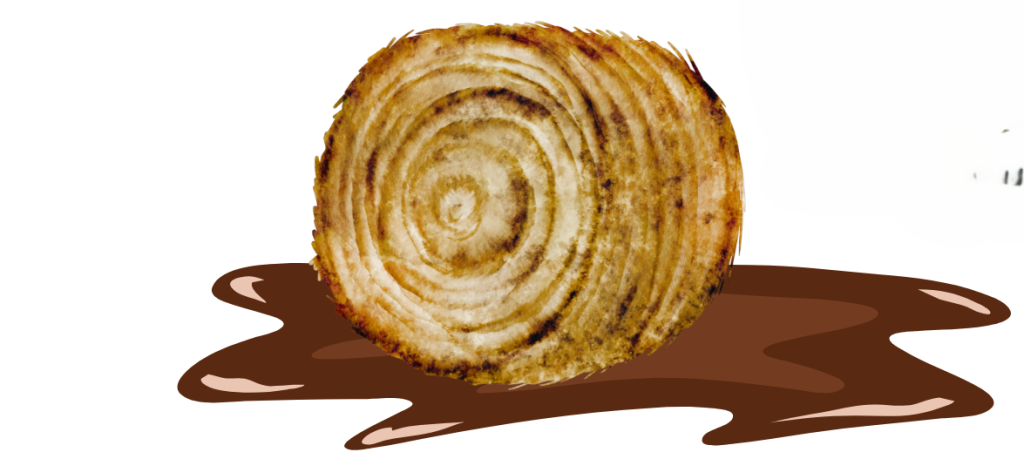
Had I figured out that muddy conditions significantly increased the cost and amount of feed, I would have started sooner! Animal studies explain that animals standing in mud expend extra energy constantly shifting to gain firm ground, lose weight, and need more calories—the cost of wasted, uneaten good hay in yucky, wet, murky water and mud. Horses and most animals find muddied hay unappetizing.
Mud affects horses' skin and health. A horse covered in MUD may experience Thermoneutral zones, either LCT (Low Critical Temperature) or UCT (Upper Body Critical Temperature), depending on its age, body condition, health, whether its coat is clipped, the ambient temperature, relative humidity, wind, precipitation, or the task we are asking it to complete in a particular type of weather.
Skin caked with mud cannot breathe. Matted coats cannot fluff to create air pockets that insulate in cold weather, allow sweat to evaporate, or cause overheating, which can quickly become a health issue. Trapped moisture can breed bacteria and clog pores, causing skin issues. Horses will need human intervention with either mud-related LCT or UCT.
Ideally, we want an environment free of mud, which means healthy frogs and intact hooves, fewer breeding and biting insects, and less chance of our horses slipping, bumping another horse or sliding running through our gates or us breaking an arm or leg while feeding or watering them, or losing a good boot to mud. We need to find budget-friendly methods to make our pastures, barn & gate entrances, and feeding areas with Pasture Management Practices.
Creating a mud-free zone with grids or rubber mats is labor-intensive, time-consuming, and expensive. Some of us work three jobs: our family, our horses, our barns, and our property’s upkeep test us daily. We often work outside of our homes to pay our property taxes, maintain equipment, and provide medical care for our horses and family.
In a 2017 article, a university in KY specifically suggested high-traffic heavy pads (grids) integrated with 6 to 8 oz. non-woven Geo textile fabric, #4 limestone, blue stone, and other aggregates as a cure-all for MUD.
At the time of publishing the KY 2017 article stated the cost was
80 cents a square foot.
This was ALL INCLUSIVE: fabric, multiple aggregates, labor, grading, heavy-traffic pads, and equipment.
Using a KY University’s published article costs-
Item: Cost per square foot $0.80 cents`
When the mud grid idea grew, so did the price. I liken the increase in the price of formerly commonly used and marketed items that later became equine products. Someone slaps a horse picture on them and triples the price. I apologize for the sarcasm.
To make my point, look at mag. In 1997, mag was $1 a bag, and it lasted 12 months! Clients tell me it’s 6 months now, and it ranges from $16 to $22 a bag; at times, it’s scarce.
A new 2024 quote for Grid-MATS ONLY
A 2025 quote for a complete heavy-traffic mat system with: 2-3 TYPES OF AGGREGATES, ROLLS OF non-woven FABRIC, Excavation GRADING Equipment, and LABOR.
ONE 20’ x 20’ area costs $5,560.
So, in answer to the Blog’s Title:
YES, Heavy-Traffic grid mats are expensive.
PastureDRY costs $329.99 and treats (10)—20’ x 20’ areas.
Walk with me on this.
As the former wife of a custom home builder, I was somewhat skeptical when I first read about the heavy traffic grid systems for cattle in 2017. Common sense would prevail that an area blocked by impenetrable, non-woven fabric would not drain and become susceptible to overflow.
Let’s use a household round bucket as an example: Buckets do not drain, similarly to how the KY article portrays non-woven fabric. Place 4 inches of big gravel at the bottom of the bucket, then add 3 inches of smaller gravel on top of the big gravel. Place a round colander as if it were the grid mat. Pour water to the brim. Does it drain, dissipate, or stand stagnant?
Statement: Well-fed horses produce 50 pounds of manure & 3 gallons of urine per day. Add Nature-snow & rain. Will our bucket drain? NO!
Customers will likely become disenchanted with their expensive grid systems' flaws as their gravel pits overflow with rain, snow, and accumulate twigs, tractor tire mud, hoof mud, Fall leaves, urine, and manure. Where will the sludge water drain? Trapped manure and urine will reek of ammonia, particularly in warmer weather, and attract known disease vectors, such as biting blood-seeking horse flies and pesky gnats.
The mat system reminded me of French Drains, which homeowners request landscapers install in waterlogged areas of their yards. The large pipes typically become plugged despite being cloth-wrapped when they fill up with dirt, clay, and debris, and fail in 1-2 years due to the design concept, poor application, or the volume of liquids they are asked to dissipate.
DAILY MAINTENANCE of GRID MATS: Grid promoters suggest removing straw, manure, or any type of bedding material or feed material daily. This debris will fill the nooks and crannies of the aggregates.
In addition, newer instructions for the heavy traffic grid mat system include a new engineered design for prepping the base of the grid bed: “creating a 5% drainage slope” toward a well-vegetated discarding area to prevent illegal drainage to underground freshets, nearby wells, and streams that lead to waterways or your freshwater ponds. Oh, my!
Grid promoters indicate you may need to add materials every several years.
Newest Heavy Traffic GRID SYSTEM ADDENDUM: grid promoters now suggest maintaining a grass filter strip along any downslopes or heavy-use areas to trap sediment and pre-empt illegal pollutant runoff.
Importantly, please consult your local county environmental agency to ensure you drain it into an area that can withstand all the liquid, based on snow or rain precipitation and urine accretion from the number of horses or animals utilizing the area.
WHY BECAUSE IT’S THE LAW
The Clean Water Act (CWA) establishes the basic structure for regulating discharges of pollutants into the United States' water and regulates the quality standards of surface waters. The act was significantly reorganized & expanded in 1972 as the “Clean Water Act.”
Under the CWA, the EPA has implemented pollution control programs such as setting wastewater standards—the EPA National Elimination of Pollutant Discharge. EPA has also developed national water quality standards, criteria, and recommendations for pollutants in surface waters.
Animal Waste from Animal Operations. CAFOs that are not controlling their animal wastes and illegally discharging pollutants to water bodies are a serious threat to water quality and human health.
Wetlands - Discharges of Dredge and Fill Material. EPA ensures that dredged or fill material is not discharged into wetlands and other waters of the United States except as authorized by a permit issued by the United States Army Corps of Engineers. EPA investigates and inspects those discharging dredge and fill material into wetlands and other waters of the United States without a permit and pursues appropriate enforcement to ensure compliance.
The CWA made it unlawful to discharge any pollutant from a point source into navigable waters unless a permit was obtained:
Order, receive, stage, and handle OR pay a contractor or subcontractor's
*It is best to have adults present to sign for the materials or rental equipment.
Receive & stage:
Pallet(s) of heavy rubber mats
Pallet(s) of non-woven fabric (minimum three rolls)

*Ensure you schedule your installation experience soon after the fabric arrives. Non-woven fabrics are ultraviolet-sensitive, resulting in faster degradation from UV breakdown, surface degradation, and reduced tensile strength with high UV exposure.
Rent equipment or hire a contractor with:
Preparing the site for heavy grid mats:
Measure & mark the area for excavation with utility flags or other
Remove 8-12" inches of your topsoil, trees, old stumps, or tree roots with an excavator. (To reach hard clay, your barrier, which is why it won’t drain)
Comb the area to level & use a level to ensure
Meticulously install Class SE, 1-4 (your choice) of non-woven fabric, overlapping each section by 12 *Sprinkle several handfuls of 2-inch gravel to hold the fabric in place as you layer and overlap it.
Place 6 inches of #2-sized stone (2-1/2 inch in size) on top of the non-woven material. Level the stone.
Then compact stone #2 stone with an industrial type of heavy-duty roller that vibrates & levels
Install 4 inches of Blue Stone & level it.
Compact Blue Stone with an industrial type of heavy-duty roller that vibrates & levels
Using a forklift, lift the heavy mats, drag them into place, and then puzzle them to fit your bed.
Rent an appropriate-sizeddumpster for the project to contain all the debris, such as boxes, cellophane wrap from pallets, or human-made luncheon material and water bottles.
As the ex-wife of a contractor, I would suggest renting an outhouse.
Lastly, arrange for someone to buy or pick up leftover pallets or take them to be recycled.
PastureDRY™ - mud eliminator vs. MUDGRID mats
PastureDRY™ is a liquid spray-on, concentrated proprietary formula of agricultural minerals and elements that improves soil & creates percolation, allowing water to drain and your topsoil to dry.
For example, one gallon of PastureDRY™ treats 4,000 square feet to a depth of 8-9 inches, and it costs $329.99 with FedEx Free Shipping.
Examples: (4) 25 x 40 paddocks or (1) 40 x 100 or (2) 40 x 50 paddocks
*PastureDRY™ can treat from 8-9 inches or the depth of an Olympic pool.
Soil Preparation for PastureDRY™: ZERO
Soil becomes waterlogged when a water barrier, such as Clay, Hardpan, or Caliche, stops water from draining and turns it into standing water and/or perilous mud. Typically, a water barrier is 8-9 inches deep but may vary per property.
Lifeless, waterlogged soils erode and become easily compacted, creating poor root health or crusting over poor soil. They are unhealthy and dangerous for human and animal health.
Good, healthy soil comprises clay, sand, and silt granules organically glued together by decaying plant materials, earthworm excretions, sticky soil microbes, soil minerals, and microorganisms like fungi and bacteria. When you pick up a handful of good soil, it’s moist but not wet, and it initially stays together for a few seconds, then surrenders a few crumbles that smell like good earth.
Without pore space, soils are prone to crusting, root diseases, run-off, erosion, compaction, standing water, and creating MUD.
PastureDRY createsa healthy pore space for rain infiltration. Pore space is vital to soil; good soil retains some moisture to sustain crops during drought.
With good drainage, the plant's roots can generate organic “glues” and soil microbes, fungi, and bacteria that improve aggregate strength. Before long, this diverse soil attracts busy earth-moving worms, creating more nooks and crannies for drainage and excreting vermicast, the best soil medium ever.
A Good Read Cornell University Cooperative Extension’s Agronomy Fact Sheet #95 by Sarah Hetrick, Quirine Ketterings, Karl Czymmek et.al.,a short 2016 scholastic article.
PastureDRY™ is formulated from a proprietary blend of agricultural minerals. It is ecologically friendly and environmentally safe. The formula was approved in California in 1971. The product was initially used to correct the soil’s pH, remove old chemicals and salts that inhibited plant growth, grow organic and healthier plants, hold moisture, restore soil productivity, and eliminate standing water that suffocates plants and trees' root systems.
PastureDRY™ has been successfully used to create soil percolation of standing water in places where horses congregate, on dirt roads in front of barns, gates, feeding areas, deer stand paths, paddocks, run-ins, horse trails, polo fields, mailbox areas, sports fields, racetracks, pastures for horses or crops are grown.
For more information, visit PastureDry’s website www.pasturedry.com
Equipment needed for PastureDRY
NONE, ZERO, NADA
NO HEAVY EQUIPMENT NEEDED
NO PILES OF AGGREGATES NEEDED
NO PALLETS
NO non-woven FABRIC
Household type items for PastureDRY™ MUD control.
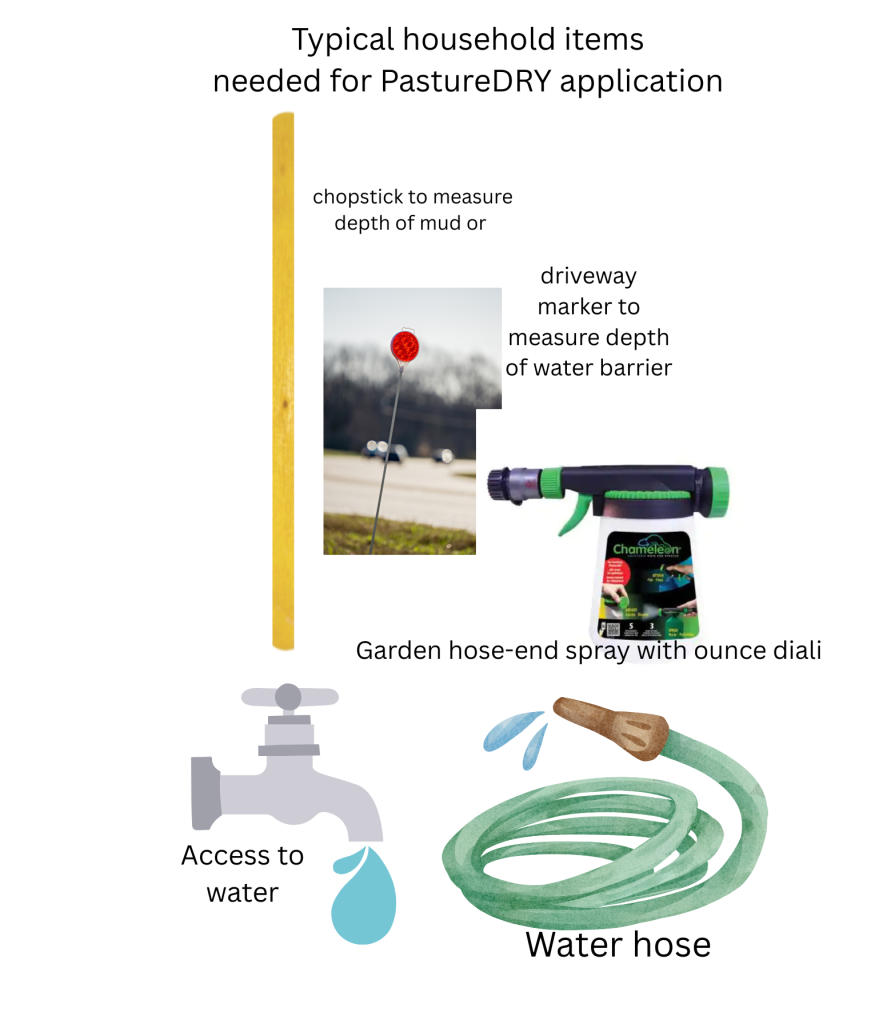
A chopstick or driveway snow stick to measure your barrier’s depth
A hand-held quart garden-type spray with an ounce dial on top
A watering hose with access to water
Feel free to ask John any questions BEFORE applying by calling 330-388-3197
*We want you to be happy with our products and to ensure you receive all their qualities and benefits.
Measure the depth of your mud with a stick in several locations, average it out & adjust the sprayer’s dial accordingly. (The average water barrier depth is 9-10 inches)
*It is helpful first to watch John on our website spraying an arena with Arenaclear™; it’s the same process and pace.
Fill the quart sprayer with PastureDRY™ liquid concentrate.
Double-check the sprayer’s dial setting for the correct dilution formula for the depth of your mud’s barrier.
Attach the hose to the garden sprayer and turn on the water.
A general rule of thumb is "one and 1/2 ounces" of PD per gal. for a gator or truck water tank to reach the typical 9-10 inch depth.
NOTE(s): PastureDRY™ needs enough water, mild rain, or melting snow to reach the water barrier, i.e., clay, caliche, or hardpan, that is blocking your water from draining. *PastureDRY™ works quicker during warm temperatures, just like people.
How long does PastureDRY™ last? Years or almost forever.*
Maintenance: Occasionally, using your sprayer, spray a little PastureDRY™ on accumulated manure, hay, leaves, or mud tracked from other areas.
*Note: Do not add shavings, wood pellets, wood chips, or straw to the treated areas; this is the recipe for adobe brick, and it will create a NEW water barrier.
Anywhere there is mud or standing water, it can be formulated using the correct amount of product and water to reach any depth. For example, it can be used to pre-excavate a swimming pool in a Hardpan area like Las Vegas or Scottsdale. It will dig like butter—no need for a jackhammer.
If you have difficulty getting through your pasture’s mud to feed or water your horse, think PastureDRY.
If you cannot reach your deer stands due to mud, think PastureDRY. Treat it in late summer and let the rainwater in.
A standout from JPI Corporation, out of Irving, TX. During a year of heavy rains, JPI was building a multi-family 500-unit luxury apartment complex in CALIFORNIA and could not pass its percolation test to pour concrete pads. Our product was already approved in CA & we shipped it quickly. They were behind schedule and losing $7,000 per day. A few days after applying our product, they had 18 inches of percolation,passed their tests with flying colors, and construction commenced.
Carlsbad, CA- Hardpan: A gentleman and his family moved to Carlsbad, CA, from Springfield, Illinois, and wished to put in a pool for their children and enjoy the new climate. He called several pool companies to come out and give him a price.
Two pool companies returned with bids of $9,000 and $7000 to dig the prospective area with jackhammers. That’s how hard it was. Instead, the owner bought fifteen gallons of PastureDRY, applied it, and added copious amounts of water. A week later, the construction company came to assess the area and found it dug like butter with a shovel. The owner did not need to pay the extra $9000 for special equipment and manpower for Hardpan excavation just for the pool.
About US.
We have been in the equine & animal care industry for over 24 years.John, our company's brawn & math brains, took on Stall DRY Deodorizer™, Barn Fresh™, and Red Lake Diatomaceous Earth™, an anti-caking agent feed additivefor large operation poultry, egg layers, dairy & hog farms, with John at the helm as the National Marketing and Distribution President, there was a quick expansion. People were eager for ammonia control, and he needed more manpower. John hired me as Vice President of Marketing and Sales Training Director.
I know some of you love Sweet PDZ™, and that is great. If the horses, animals, and their humans are experiencing less ammonia, I am happy.
When John started with Stall DRY in 1997, he had one distributor in WA. As a team, we set up 18 Stall DRY distributors who sold it to your local feed stores throughout the United States, including in HI. Next, we set up chain stores: Orscheln’s, Mills Fleet & Farm, nationwide Tractor Supply stores, and more.
John established feed mills and distributors nationwide with StallDRY, Red Lake Diatomaceous Earth & Barn Fresh. We both traveled with our distributor’s salesforce to their clients' ammonia-laden dairy barns, horse barns, grower poultry houses, and egg layer houses. This was challenging for me, as ammonia is another COPD/Asthma trigger.
After approaching equine facilities often on dusty roads, visiting dust-laden barns and arenas, we started producing Arenaclear Dust Control. Controlling fugitive dust from outdoor and indoor arenas was essential for horses' and humans' health. Convenient yet unhealthy horses are typically stalled within 20 feet of their arenas 24/7.
Neither was dredging in mud past my hocks. (That’s supposed to be funny and draw a good picture.) Mud feels disconcertingly like quicksand. Your horses or you can break a leg or arm; it’s a safety hazard. Mud breeds biting, blood-sucking horse flies, mosquitoes, and gnats that carry viruses and diseases. Mud is a cesspool of bacteria.
We want horses, animals, and people to be safer and healthier.
I hope you enjoy the article.
Feel free to ask questions.
MUD MANAGEMENT METHODS (MMM)
BOOTSUCKIN’MUD™ Blog Series #3
Why did the World invent mud anyway?
Mud and its harmful qualities are written about in great horse magazines and scholastic papers, but I have not encountered one that gets to the bottom of mud.
The next several blogs will answer your questions about mud in Bootsuckin’MUD Blog Serie 1-7.
Learning about mud entails learning a geologically abbreviated version. It reads fast.
"We, of course, know the final outcome, but we should not let that influence our appreciation of the story as it unfolds." Source: Scientific America.
The Universe is littered with flying objects, and collisions are inevitable. According to NASA, about 4.5 billion years ago, our planet gained momentum as a succession of varying-sized dust particles & Nebulae-like swirling gases that produced a gravitational pull attracting Meteoroids, Asteroids, Comets, and other celestial objects. Lucky for us, the galactic bodies that gelled contained eight essential minerals: Oxygen, Aluminum, Iron, Potassium, Sulfur, Magnesium, Silicon, Calcium, and Sodium, precisely what our planet needed to develop Earth as we know it.
Core, Crust, water.
During the creation of Earth, meteoritic rocks were so hot that they changed types back and forth from metamorphic to igneous or sedimentary. This volatile cocktail of gases, elements, and minerals was liquified into molten magma, frothing and churning. Heavier metal elements sunk inward, and the lighter elements floated upward toward the surface. The heavier elements, nickel and iron, formed our core.

But Earth was not finished as volcanoes violently ejected rock fragments called tephra into the atmosphere, landing miles away, destroying and littering the planet with fragmented Montmorillonite and Leonhardite. Lava flowed, mixing with igneous, sedimentary, and metamorphic rocks, then cooled, and land mass grew.
Fifty million years later, the atmospheric gases transformed, allowing heat to be released and the Earth to cool further. The lighter basalts, rocks, and granite rose as slag hardened into Crust.
It became so temperate that it allowed water, deposited by crashing, water-rich planetesimals asteroids and comets, to collect and pool in deep crevasses, quarries, future riverbeds, and ponds.
Late in the Triassic-Carian Age, or 232 million years ago, after millions of years of being nothing but dry Crust. Water mixed with the gases emitting carbon dioxide that enhanced evaporation from the quarries & ponds, seeding continual collections of vapors from the oceans and waterways that formed clouds, and it rained throughout the land for 2 million solid years.
ALL OF EARTH WAS UNDERWATER: A Harvard-led study calculated that 3-4 billion years ago, the Earth's Primordial Ocean's internal water storage capacity may have been one to two times larger than it is today. With that much water, it may have covered the planet's entire surface & one to two times larger than today. Source: Harvard Gazette- Junjie Dong Ph.D. Planetary Sciences

Kevin Costner would enjoy knowing he was right; Earth was a Waterworld. Presently, much of the planet's water is continuously subducted through naturally occurring subsurface aquifers and carried deeply under the tectonic plates. This process still happens today as part of the cycling Hydrosphere System that extends 9 miles upward into the atmosphere & downward past the Crust 3 miles deep, keeping the core temperate & somewhat restrained. This system circulates endlessly: like chilled air, the cooler water drops down, slipping under mantle plates, keeping the core temperate & controlled, while warm water escapes upward to cool, circulating & exchanging repetitively.
Presently, our combined oceans contain 352 quintillion gallons of water. Lake Superior, the World's largest freshwater lake, holds three quadrillion gallons capable of flooding South & North America to 1 acre-foot.
Water is very heavy, placing our lakes & oceans under tremendous pressure at 3,000 to 9,000 pounds per square inch. Saltwater weighs about 8.6 pounds. Fresh rainwater weighs in at 9 pounds a gallon. Flowing water weathers rocks moves sediment & extracts its minerals as it tumbles on its journey, and that settles across both the land and ocean floor to create a crust of Shale & Mudstone to hold it all together, much like our skin holds our bones & organs together.
Layer by layer over time, throughout ALL 196,940,000 square miles of Earth’s continental layers & oceanic floors, water pressure exerted tremendous weight, compacting the sediments, minerals & elements to form Earth’s impenetrable Crust from “an ancient mud” geologically called Mudstone and/or Sedimentary Shale that hardened, and water cannot penetrate.
Over eons, Earth went through tremendous growth patterns, some with plant life, trees, dinosaurs & animals, followed by mass extinctions caused by other terrestrial objects crashing on our planet, emitting gases and debris into the atmosphere that obscured the Sunlight. Earth went into snowball mode.

Each period of extinction laid beds, layer after layer, of decaying plants, trees, leaves, grasses, organisms, animal bones (nature’s bone meal), nutrients Nitrogen, Phosphorus, and Potassium mixed with air and moisture, creating humus-stabilized old carbon, which glues micro-soil together. A centimeter of topsoil takes a thousand years to form. We know it as A-Horizon humus topsoil.
But soil does not stay intact; weather forms our landscapes. All the planet’s dirt is never geologically static, it shapes then reshapes itself sporadically uplifting. The ingredients of our soil are always changing, leaching its minerals & elements to layers below or moving, blowing in the wind or whisked away by water. Over time, mountains & volcanoes collapse, grasses, plants & trees die, rocks tumble & minerals flow weathered by wind, snow, or erosion.
Topsoil is always evolving based on what nature or you throw at it. It is a living thing. It contains 45% minerals, 5% organic matter, air & water. Whether it can sustain crops or plants to build a microbial life to support them depends on Nature's contribution, weather & humans.
Answer: During Earth’s creation, sediments from crashing comets & asteroids, minerals, and elements mixed with water covered the entire Earth. Over time, the weight of the water squeezed out each subsequent layer of sediment, compacting it into a hard, impenetrable CRUST, a water barrier. When the water reaches CRUST, it cannot drain.
Ideally, CRUST should be: 6-9 inches below your topsoil. Often you find an impenetrable barrier at less than that or completely exposed topside. The less topsoil you have, through natural forces, animal management or human hands the more likely you are to have mud. Water needs somewhere to go.
When water on soil reaches the barrier and cannot drain, it becomes mud, which is why you have mud.
We hope you agree it is not an environment you or your horses or animals should live in.
For that reason, we produce PastureDRY™, made initially to correct soils & renew them as Mother Nature intended healthy, rejuvenated and drains.
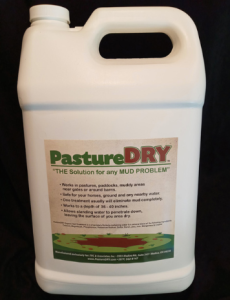
PastureDRY™ is a unique proprietary concentrated liquid spray-on, safe, agricultural mineral & soil conditioner that breaks the barrier and allows water permeation & your topsoil to dry.
All you need is a hose-end sprayer and access to water.
Please visit our website at PastureDRY.com or call 877-562-8147 with any questions.
MUD MANAGEMENT METHODS (MMM)
BOOTSUCKIN’MUD™-Blog Series #1
Losing your good boot or horse's shoe in mud was a recurring event for me. Hiring or gassing up your heavy-duty equipment to extract an ATV or tractor from a mud bog stretches human resources and is time-consuming. Mud indisputably creates safety, health & potential litigious issues. It can be more severe when it is life-threatening, how a limb breaks, subsequent emergency room fees, downtime to heal & loss of earnings.
After a wet season of mud, are you left with a stack of farrier or vet bills for rain rot, infected cracked open wounds, abscessed hoofs, greasy heal, or white line disease? You or your horse may experience tendon soreness or ligament injuries after a class ride in a muddy arena, paddocks, or pastures. The bills and health issues may serve as a reminder to find a remedy for your muddy areas.
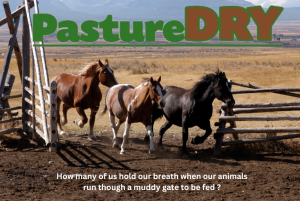
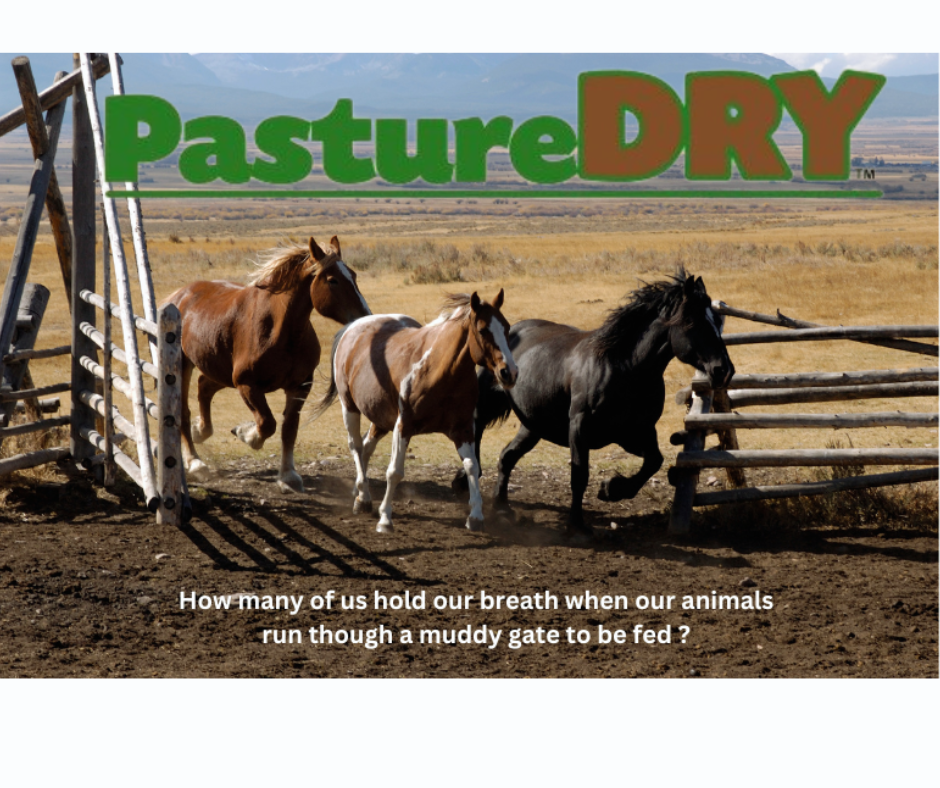
Don’t we all hold our breath when our animals race up to or through a muddy gate to be fed, hoping they don’t slip under a fence or get bumped & and slide? And then there is the hardest: deciding to put down a valuable companion animal with a broken leg after a fall in mud is heartbreaking.
Mud has no boundaries or Seasons when it is not a nuisance, health or litigious issue, or much worse. It may be time to tackle your mud mires.
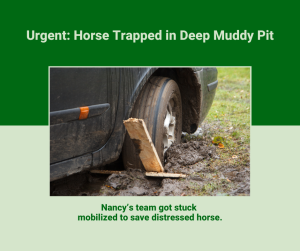
In the Fall of 2023, the mud in my friend’s pasture was like quicksand and swallowed a mare up to her thighs; she was trying to use her forelimbs to get out. Nancy returned to mobilize a team but got stuck before it could reach the scene. Nancy traded in her dually for a tractor, blankets, and a rope. I walked into the mud willingly, trying to keep her mare calm, knowing she would need all her remaining energy to help pull her out. Soon, I was stuck up to my calves. We both felt uneasy, uncomfortable, and helpless.
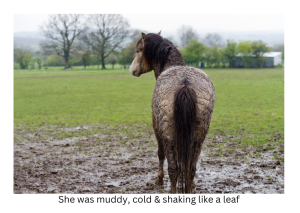
After we got her out, she was caked in mud, cold & shivering like a leaf. This scene happens more commonly than you would think. It could be a new foal, its mother, your cattle, or yourself. As a precaution, I always take my phone when heading into someone else’s muddy pasture or hunting a missing animal, more than likely stuck in the mud, hypothermic, caked with mud, depriving them of the ability to hold heat. That day, I lost another boot, but not the mare.
You may have been in similar scenarios, you could add. I would like to hear & share them.
Mud is more than a nuisance. Mud breeds parasites, viruses & insects. Who wants to train a horse or ride in a swarm of hungry female mosquitoes and blood-letting horse flies ripping your skin to get their meal that developed in your mud puddles?
You can only blame the mud puddles and manure piles for breeding the females, as they are the only ones that require blood. Horseflies use a plunger called a proboscis thrust into your skin to slurp blood. Female Horse flies painfully TEAR skin with a laser-like cutter and then secrete an anticoagulant with their saliva to keep the blood flowing. Her saliva may cause an allergic reaction in humans or your horse, or she may share a virus or a disease with her dinner host.
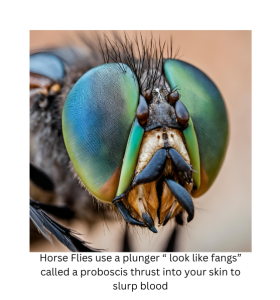
If it’s time to gain some MUD MANAGEMENT METHODS Bootsuckin’MUD™ Blog Series
1-7 will answer your questions & share MUD MANAGEMENT METHODS that work.
We will cover:
Where does MUD come from? How did I get mud?
Why do I have mud? What makes mud? How do I get RID of mud?
_____________________________________________________________________________________
DUST is my DEATH & My LIFE
This is me; this is us.
I know “they” say you are not supposed to start a blog about yourself. Still, in this case, it is essential to know who I am & that my material and quotes are solid.
I am not a salesperson selling gobbely-gook (pronounced gob-bel-lee & made up) from behind a desk, slapping a picture of a horse label on it, diluting it so it only works 6 months & quadrupling the price. That might kill all your fish in your pond or rust out gate hinges, horse trailers, or your dually parked nearby.
As one of the owners of ARENACLEAR, it is my livelihood and my life’s savior. After all we live what we breathe. I call it “having skin in the game”.
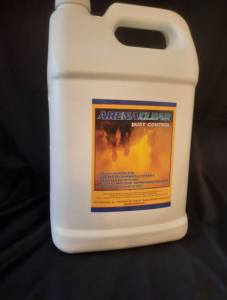
I can confirm that dust can be detrimental, having had two DUST-related near-death experiences.
___________________________________________________________________________________
I memorize written words. Over the past 50 years, I have acquired three three-drawer lateral files full of trustworthy, vetted material. There are too many mentions of computers crashing and losing a lifetime of material. I am old-fashioned and like hard copies to be certain of the source and their copyright rules.
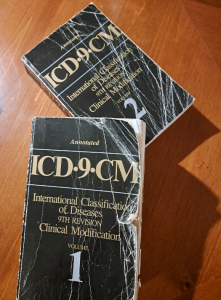
In adulthood, having a photographic memory of everything I read helped me pass all my state boards by verbal spelling & writing, including anatomy, chemistry, and much more. I kept my well-worn ICDs, Volumes 1 and 2; they are still very handy.
After thorough research and cross-referencing, I share transcribed facts and information on our website, blogs, published articles, and Facebook posts from Scholastic Studies, PhD’s works, State or Government Agencies, and national and international Health Agencies.
Sometimes, I may rephrase the statements because they are too dry or add tidbits pertinent to the equine industry or animal or human health. I use words to elicit a picture, spurring you to better health.
I have been published twice internationally on subjects in my field.
You may find them on our website, www.ARENACLEAR.com Ammonia & Dust.
____________________________________________________________________________________
My reading obsession & ability came very young, guided by my mother. I had thick, long, unruly hair. Trying to gain some control, Mom perm-waved my hair. Afterward, I looked like a standard poodle on steroids. 
My mom took a new route & put my hair in rollers, set me down in a backward chair, and put me under a bonnet cap hair dryer (which looked like a giant shower cap from outer space); she would hand me one volume of World Book Encyclopedia & a Webster Dictionary then walk away. I was to look up any word I did not know the meaning of with my dictionary. She started with A. This happened twice or three times a week if I got my hair dirty; mom had mild Mysophobia. I guess she was trying to share it! I remember going through the set & then starting again in the middle & for kicks, starting with Z working backward.
By 12, I would have made a great Jeopardy contestant but would have been bald from the heat and rollers (just kidding), and I have my mother to thank for that. With a youthful eidetic memory, pesty questions about little-known foreign river names would have been a piece of cake.
I still read incessantly, searching for innovative products or cures, studies, and current information; it fascinates me.
My interest in horses started young. I watched everything with a horse: Black Beauty, Fury & Roy Rodgers with Trigger. The first handmade gift I made my mother was a horse napkin holder. I am sure she loved it.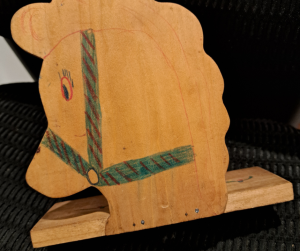
I learned to ride at Metropolitan Park Stables in Ohio in the 1960’s. After an hour of practice during an outdoor arena event on a warm summer August day, they told me I had fallen off the horse, not because of fault but because I had lost the ability to breathe. I flatlined. One of the instructors was a large animal vet, and although she should not practice on people, she breathed for me and saved my life. They thought since I landed face down, I may have died from Commotio Cordis. They called an ambulance and sent me to Fairview Hospital, where they worked hard on me.
The doctor said I was “LOST” on the way there, but the paramedics revived me. My ribs were sore, to prove it. We discussed the day's happenings, and after some breathing tests and x-rays, he declared I was “allergic to dust.” He furthered that due to acquired COPD & Asthma, I was likely on my way to Silicosis, “my days in arenas were finished.” In 1964, dust control products other than water were nonexistent. We know water alone does not do much nor last long.
When the Occupational Safety & Health Administration OSHA states “that exposure to Silica Dust has been classified as a human lung carcinogenic’, “use all available work practices to control dust exposures.” In addition, it can mean life-long bronchitis, kidney disease, COPD, lung cancer, pneumonia-like symptoms, breathing difficulty, tiredness, weakness or even death. I believe them; I am “living’ proof. (just to be confusing)
____________________________________________________________________________________
I went to Catholic schools, but don’t hold that against me; my knowing mom sent me there because there were no boys, and the Notre Dame nuns enlisted all means to ensure I studied. I am just honest. It meant I learned a foreign language, Latin (daily mass), without realizing it, and it helped later during my studies for state boards.
The movie with Hayley Mills, “The Trouble with Angels,” should have been written about me. It is a cute movie. Boy, could I add mischievous storylines? (Ask me about Tabu at our next show)
One drawback of Catholic schools in those days was that they did not teach phonics. I passed all my state boards by spelling words as long as my hand, verbally or written on paper.
Going to Catholic high school meant riding three city buses to reach them. I learned the bus schedules and made them work for me. One bus stop became my favorite: the Cleveland Public Library in downtown Cleveland—the perfect venue to search for studies & a cure to return to my equine passion.
That building’s architecture and curved staircases are breathtaking. If I had timed it right, I would have time to hunt for studies on dust and its respiratory effects, walk the pristine marble floors, and descend the curved stairwells like a princess
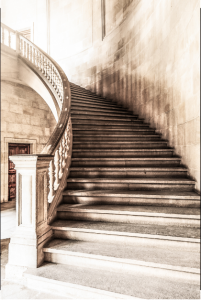
I tried perilously sliding down one, but that didn’t work out well.
Daily, the floors and my uniform’s required trappings put me at odds with the librarians. My saddle shoes clopped and echoed throughout the marble hardscape; I sounded like a Budweiser Clydesdale. Everyone could hear me coming. Librarians would scowl behind their thick black glasses while I stood before them, and without looking up, they would say, “Yes, Theresa, what can we help you find today for your reading pleasure?”
There was little on the subject, consisting of two pages on microfiche under lock & key. Yes, I know I am old, and now my eyesight is dull after reading tiny words on the harmful effects of dust on humans via microfiche. ___________________________________________________________________________________
Years later, I became a busy working mother of two. Eventually, when they were a little older, we made 128 dozen Christmas cookies (not a type-o) to share with our extended family. Thumbprints are time-consuming but a favorite, and my youngest had the perfect-sized digitus primus manus for jelly. (why not” digitus primus womanus”?)
Children are mischievous, and the youngest sitting on the counter was stirring the gigantic batter bowl. Grinning, he grabbed a handful of flour and threw it at his older sister. She returned the favor, and we all joined in. It had been ten years since I had had an episode. I had forgotten the effects of dust on my lungs. Once again, down, I went out like a light, and within a few minutes, I was technically dead. The reviving neighbor… Larry, a firefighter who later became chief.
A personal example of my research, I share that what brought me to death’s door does not make it better, just known.
How important are macrophages?
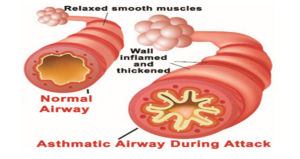
The Macrophages (scavenging cells) help dissolve & resolve smaller-sized respiratory dust particles. If there is too much dust, the scavenger cells cannot completely clear dust from your lungs, and you suffocate without oxygen. Dust can mean death in an episode.
___________________________________________________________________________________
Much later, John, our company's brawn & math brains, took on Stall DRY Deodorizer, Barn Fresh, and Red Lake Diatomaceous Earth, an anti-caking agent feed additive for large operation poultry, egg layers, dairy & hog farms, with John at the helm, as the U.S.A. National Marketing and Distribution President, there was a quick expansion. People were eager for ammonia control. John hired me as Vice President of Marketing and Sales Training Director.
I know some of you love Sweet PDZ, and that is great. If the horses, animals, and their humans are experiencing less ammonia, I am happy.
When John and I started with Stall DRY in 1997, we had one distributor in WA. We set up 18 Stall DRY distributors who sold it to local feed stores throughout the United States, including in HI. Next, we set up chain stores: Orscheln’s, Mills Fleet & Farm, nationwide Tractor Supply stores, and more.
John set up feed mills and distributors nationwide with Red Lake Earth Diatomaceous Earth & Barn Fresh. We traveled with their salesforce to their clients' ammonia-laden dairy barns, grower poultry houses, and egg layer houses. This was challenging for me, as ammonia is another COPD/Asthma trigger.
____________________________________________________________________________________
It wasn’t until my 30s that KY Equine Research Center wrote a study titled “Small Airway Disease & Equine Respiratory Health " that I realized horses suffered from the harmful effects of DUST (now given newer acronyms): IAD, RAD, EIPH, and CIA.
Emission Factors Fugitive Dust Sources #13.2 “Significant atmospheric dust arises from the mechanical disturbance of granular material exposed to air.”
_________________________________________________________________________________
ALL arena footings contain FREE CRYSTALLINE SILICA (dirt, clay, rubber, or fiber with sand).
Everyone exposed is at risk; no one is immune; everyone is harmed by FCS dust. Feel your hair, look at your boots and cheeks. If you are brave, swipe them with a tissue or paper towel. Now, I want you to imagine what your lungs look like.
Dust fines bury themselves in the cushy folds of your lungs. This irritates them, and they rebel by continuously covering them with collagen, creating fibrotic nodes that grow thicker and thicker, leaving little room for air. (I will use this over and over)
Diabolical fines find their way into the deepest depths of the lungs, which can be an immediate problem or a later one, but it will be one.
Unless you control your dust.
At risk: Barn Managers, muckers, instructors and their students, innocent siblings, Judges, parents and grandparents, your neighbors, and the disadvantaged that you welcome.
May I highlight that rarely does anyone think of the horses in the barn, some as near as 10 feet from the arena, their fugitive source of harmful dust 24/7?
We expect them to be our practice horses or wish them to be our 1st place champions, but we deprive them of their biggest biological need: clear/clean oxygen.
Oxygen is their lifeblood; it infuses every cell & muscle, enabling them to achieve their best barrel performances and highest jumps.
_________________________________________________________________________________
While working at the horse shows for Stall DRY at Equine Affaire’s three shows, the OHIO Quarter Horse Congress, the Midwest Horse Fair, etc., John and I noticed that nine out of ten women attendants asked if Stall DRY would control DUST, too.
It is no wonder women were searching. The American Lung Association states:
“By the year 2000, COPD had claimed the lives of more women than men for the first time and accounted for 53% of all deaths of COPD.” (occupational respiratory illnesses like pneumonia)
“Equestrian professions are exposed to inorganic & organic dust”.
Another research paper states: “Women are now the majority owners of horses”.
Am Lung Association “and biological gender differences appear to make women more susceptible to HARM from those exposures”.
In 2003, we traveled 252 days a year for Stall DRY, RLE, and rarely home. During Winter’s inclement weather, John met a gentleman in an airport waiting area & they talked business. Each inquired what the other did for a living.
The gentleman highlighted that he had an approved ORGANIC ag mineral-based product and fish fertilizer, both of which piqued John’s interest. They set up a meeting. Afterward, we were handed an 8-inch voluminous book to read, which I read in two days. One standout was the Features and Benefits of the agricultural mineral product. I read one paragraph aloud to John, and he decided to research the product and confirm the results. John bought the product, and we assessed it in Las Vegas in our new home's backyard, a dust bowl, and other venues. The results exceeded our expectations.
The product was approved by the State of California (one of the strictest in the nation) in the 1950s and used by California farmers seeking to renew, refurbish, and remove the chemical remains of chemical fertilizer residues so they could become Certified ORGANIC Growers. (California grows over 13% of the nation's crops, which have a 51-billion-dollar value. Iowa is second).
It made the grower’s land arable, retained moisture under arid conditions, created NO DUST, tilled like butter, did not freeze, and renewed the soil. The farmers reported that their crops grew faster and bigger, were harvested earlier, were richer in color, and looked healthier.
After buying the company, John formulated ARENACLEAR specifically to be safe for horses, animal hooves, our puppy  , barn cat
paws, and our grandchildren.
He wanted it to be affordable so the masses could use it and be healthier. He wanted it to be easy, require no special or heavy equipment, and work both outdoors and indoors.
Importantly, we wanted AC to be effective.
AC works outdoors and indoors. It combines multiple particles of dust to form larger particles. Larger particles are less likely to float; studies prove this. AC is hydrophilic, having an affinity for water. AC holds up to 300% more water (like a water balloon) deeply before slowly releasing it, keeping your footing moist longer and controlling dust. This has several benefits: heavier particles cannot float, while the “ballons” provide concussion and rebound that your horses will love (push on a water balloon, and what happens?).
ARENACLEAR, safe, effective, and TRUSTED since 2003.
Happy wife, happy LIFE (without DUST).
Teri Clark
We answer the phones. We hope you call us with any questions at 877-562-8147.
Thank you for reading our BLOG. Much more to come……